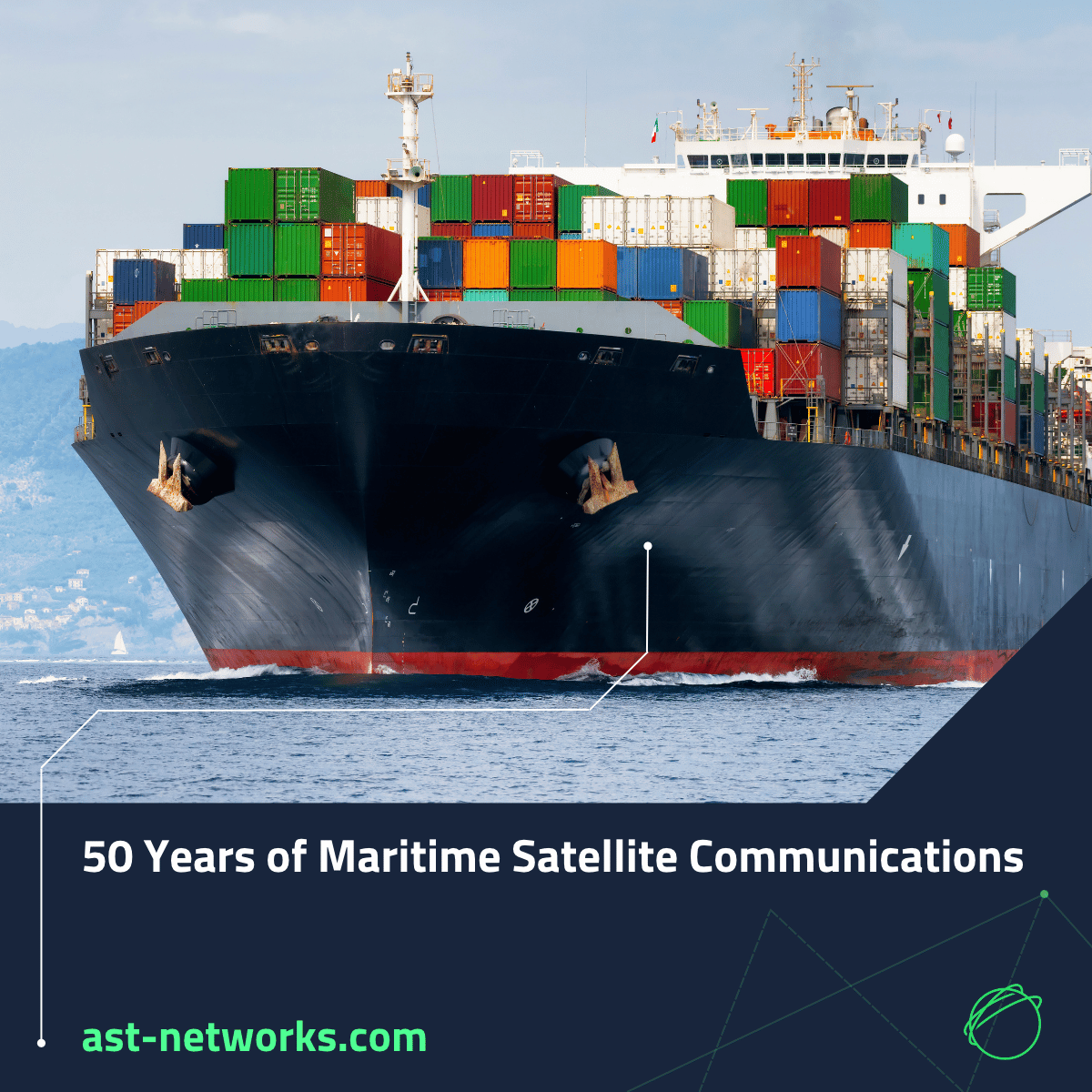
50 Years of Maritime Satellite Communications
From the first global maritime satellite communication systems to today's high-speed LEO networks, five decades of innovation have transformed how vessels communicate, operate, and stay connected. But what comes next?
In September 1976, governments adopted the convention establishing the International Maritime Satellite Organisation, known as INMARSAT. The objective was clear; improve communications with ships at sea, strengthen safety, and support more efficient maritime operations. Fifty years on and that ambition has helped shape an industry that looks almost unrecognisable from its early days.
Satellite communications have evolved from a specialist means of reaching vessels beyond coastal radio coverage into an essential part of maritime infrastructure. Today, connectivity supports everything from crew welfare and business communications to vessel monitoring, remote diagnostics and increasingly data-driven operations.
The technology has changed dramatically, the need to keep ships connected - no matter where they operate, has not.
For much of maritime history, communicating with vessels far from shore was difficult, expensive, and constrained by the available technology. Radio provided a vital link, but distance and coverage limitation presented significant challenges - particularly when urgent safety communications were required.
The development of maritime satellite communications offered a new approach by relying on signals through satellites, ships could communicate over much greater distances, including across open waters where terrestrial networks could not reach. The establishment of INMARSAT in 1976 marked an important milestone in making maritime satellite communications a coordinated international service. Operations began in 1982, and satellite communications subsequently became an integral part of the international maritime safety framework.
The significance extended beyond the technology itself - more reliable communication with vessels helped improve safety at sea, whilst creating new possibilities for ship management and communication between crews, operators, and shore-based teams.
What began as a way to overcome limitation of distance laid the foundations for the connected maritime industry we know today.
Early maritime satellite communication services were a world away from the broadband connectivity available today. Equipment was specialised, bandwidth was limited, and transmitting data costly. Satellite access was often prioritised for essential communications rather than the continuous flow of information that we rely on now.
Over time, advances in satellite capacity, ground infrastructure, and onboard equipment have expanded what was possible. Voice communications were joined by more capable data services and email and business applications became increasingly accessible, allowing vessels to maintain closer links to shore-based team. As maritime operations continued to adopt digital systems, connectivity became an increasingly important part of day-to-day operations.
The change was not simply about faster communications - it was about what those communications enabled on vessels. Shipping companies could improve the flow of operational information, support crews more effectively, and begin connecting systems that had historically operated in isolation. Satellite connectivity was evolving from a communications service into an enabler of wider digital transformation.
As expectations increased, so did the demand for greater bandwidth, improved availability, and more flexible solutions.
The arrival of high-throughput satellite services significantly expanded the potential of maritime connectivity, however, one of the most visible changes in recent years has been the emergence of Low Earth Orbit (LEO) satellite constellations.
Unlike traditional geostationary (GEO) satellites - which orbit at approximately 35,750 kilometres above the Earth - LEO satellites operate much closer to the planet. This shorter distance can help deliver lower latency, whilst large constellations provide opportunities for high-capacity broadband services. For maritime customers, those advances are substantial.
Services such as Starlink and Eutelsat OneWeb have broadened the range of connectivity options available to vessels. New entrants, including Amazon Leo (formally Project Kuiper) are also developing the market, increasing competition and creating further opportunities for maritime operators. Higher performance connections can support more demanding applications, improve the experience of crews working at sea, and make it more practical to transfer operational data from ship to shore.
Yet LEO is not simply replacing everything that came before it. Different satellite systems have different capabilities, coverage characteristics, commercial models, and operational considerations. GEO services continue to play an important role, whilst cellular connectivity can provide a useful and cost-effective option when vessels are within range of coastal networks.
The industry is moving towards a more varied connectivity landscape, in which different technologies can complement one another.
With more satellite networks and technologies available, selecting a service is only part of the decision. Maritime operators must consider how connectivity will perform across different routes, how applications should be prioritised, what happens when a connection becomes unavailable, and how costs can be managed without compromising operational requirements.
This is where hybrid connectivity and intelligent network management become increasingly relevant. Combining satellite and terrestrial networks can provide greater flexibility than relying on a single provider or connection. Systems can switch between available networks, use different connections for different applications, or combine capacity to improve performance. The objective isn't to use every available technology, but to build solution architectures that reflect the vessel's operating needs, trading routes, and budget.
Reliability also means looking beyond the internet connection itself - as vessels become more digitally dependent the integrity of position, navigation, timing, and operational data matters. GNSS jamming and spoofing demonstrate that having access to communications does not guarantee that the source of information can be trusted.
The next stage of maritime digitalisation will require a broader view of resilience - one that considers connectivity, data, onboard systems, and the operational consequences when something goes wrong.
Predicting the precise shape of satellite communications five decades from now is difficult, the pace of change over the past 50 years is a reminder of just how quickly technology can develop, however, several directions are already emerging.
More integrated networks. Rather than treating each satellite service as a separate solution, operators will increasingly look for ways to manage multiple networks as part of a coordinated connectivity environment.
Greater use of operational data. Better connectivity creates more opportunities to collect and analyse vessel data, support remote monitoring, and make informed decisions about performance, maintenance, and efficiency.
Increasing automation. As digital systems become more capable, reliable communications will help support more automated workflows, remote assistance, and the exchange of information between ships to shore.
A greater focus on resilience. Performance matters, but so does the ability to maintain essential services, manage disruption, and understand the reliability of the information on which decisions depend on.
These developments won't remove every challenge - coverage, equipment, cybersecurity, cost and the practicalities of operating at sea will all continue to influence which solutions are right for each vessel and customer. The opportunity lies in making increasingly sophisticated technology useful, manageable, and dependable in real-world maritime environments.
Over the past 50 years, maritime satellite communications have progressed from a technology primarily associated with long-distance and safety communications to a foundation for increasingly connected vessel operations. For companies working in this sector, keeping pace requires more than following the latest technology trends, it means understanding how these trends translate into practical benefits for customers - and recognising that no single technology or service will suit every operation.
AST Networks has been part of that evolving industry since 1992 and across more than three decades, we have seen maritime satellite communications change in capability, accessibility, and commercial importance - alongside the changing needs of maritime customers.
Our experience reinforces an important lesson: technology is most valuable when it solves a real operational problem. The next generation of satellite services will bring new opportunities, but the fundamentals will remain similar; vessels need dependable communications, crews need to stay connected, operators need access to reliable information, and businesses need solutions that work in the conditions in which they operate.
Fifty years after the establishment of INMARSAT, the industry is entering another period of transformation. The networks may be faster, the satellites closer, and the possibilities broader, but the original ambition is still relevant.
The future of maritime satellite communications is not just about connecting ships, but about what that connection makes possible for the maritime sector.
Contact us for more information, or visit AST Reygar to learn about vessel and industrial telemetry and monitoring.
Ask an expert
Whether you are comparing networks, choosing equipment or checking what your vessel needs, our team will give you a straight answer. We usually reply within one working day.