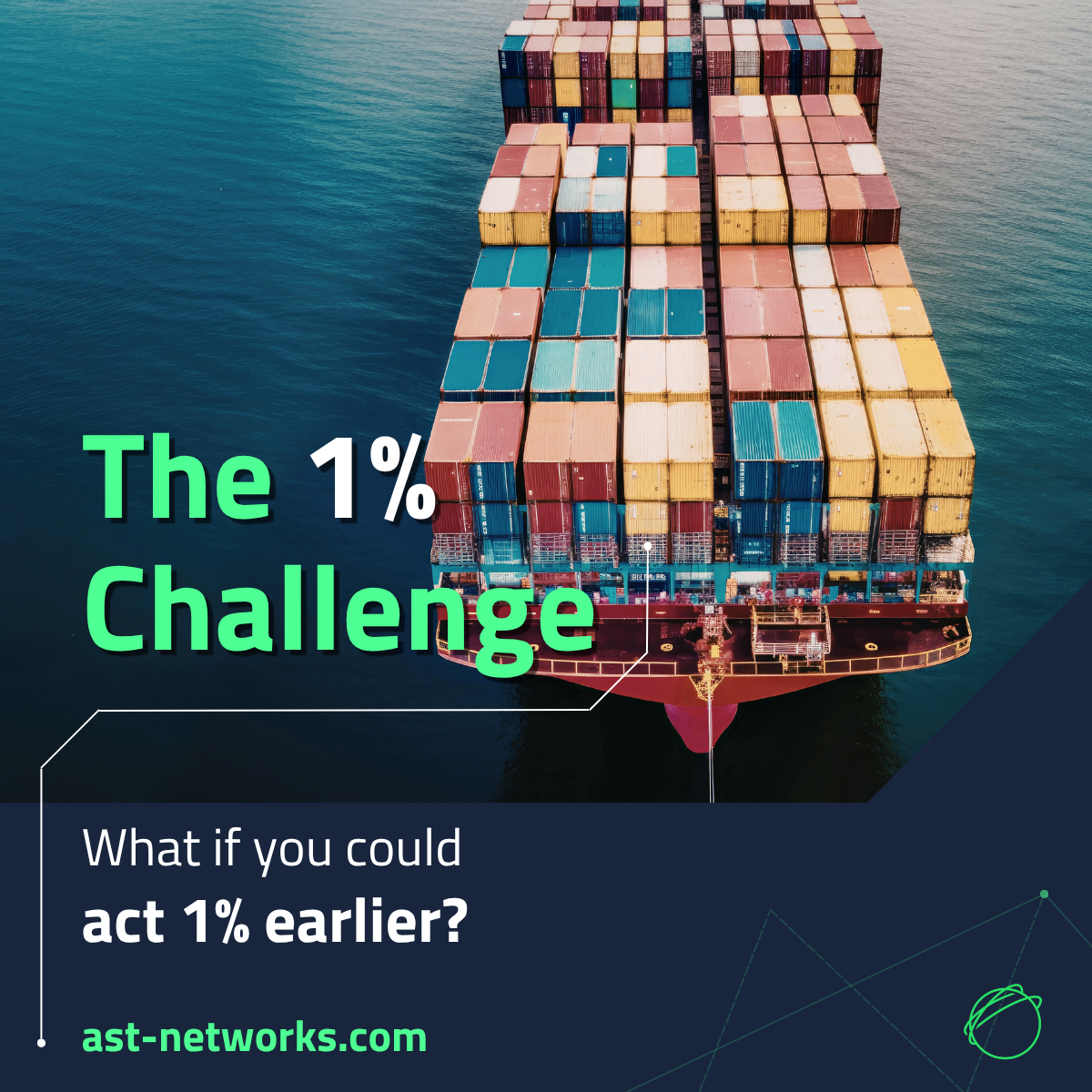
The AST Networks 1% Challenge: Act 1% Earlier
What if the the biggest benefit of spotting a change is being able to detect it slightly earlier, giving you more time to decide what to do. On vessels, timing matters.
A developing issue might not be serious enough to stop operations immediately - a piece of equipment might still be working, but perhaps not to full capacity and the sooner you can see that the more time you have to fix it. That doesn't mean you can predict exactly when something might fail, but it does mean that if changes are noticed early enough you have more time to investigate and make informed decisions on what to do about it. That's how the act 1% earlier challenge works.
A piece of onboard equipment could start performing slightly differently, but there is no alert alarm because nothing has failed and the vessel can continue to operate as normal. But if you can see that change, you can ask yourself 'why?', and that question can lead to further investigation. Conversations with crew or engineers, a review of operating conditions, or physically inspecting the equipment at the next given opportunity, can all provide the answers.
Without knowing about a change in performance, you can't see it to act on it. The difference between changes in performance and an alarm alerting you to a problem might only be a small amount of time, but that time can be valuable, it can help you act 1% earlier.
Much of vessel maintenance is naturally reactive, things go wrong and operators need to respond quickly to avoid downtime and potentially dangerous situations, but not every developing issue needs to become an emergency. If changes in performance are identified early enough, there's opportunity to investigate and plan.
Components can be checked during maintenance to avoid unplanned visits after a failure and replacement parts sourced before they breakdown completely, data can be analysed remotely to determine if an onboard vessel visit is immediately required.
The purpose of early monitoring is to avoid situations that could cause disruption, downtime, or even complete failure. Having early access to insightful data provides more opportunities to spot possible problems before they evolve - even if you only improve that early access by a small percentage, it can help you act 1% earlier to the issue.
There is a temptation to think that better, or earlier, monitoring means more alerts, and that is not necessarily helpful. If every small change triggers an alarm, crews and shore-based teams can quickly end up with too many notifications and not enough information to successfully diagnose the problem, which could mean that the truly critical alarms become lost or ignored in the noise.
Acting earlier is about understanding what changes matter and why. When you know what normal looks like it becomes easier to spot the abnormal and identify faults before they become failures. Combining information from different systems helps build a clearer picture of what is going on onboard, with the objective being to recognise small changes worth investigating, not to investigate every change - which would be exhaustive.
Vessel efficiency is more than just fuel usage and improved bandwidth. Crew time is a huge consideration. Having more time to look into potential issues reduces the pressure around decisions being made. That in turn allows operators more time to source a component before it reaches end of life, making logistics easier for supply chain and to coordinate engineers.
Even when the eventual outcome remains the same, reaching that point sooner and with more information means you have more time to resolve the problem. That's where the act 1% earlier mindset becomes interesting.
We're not suggesting every vessel needs to identify every issue days in advance, we're asking what being able to spot changes even a little bit earlier would mean to your operations. We think it could be very useful.
Remote asset monitoring and vessel telemetry can provide shore-based teams with information about equipment and operating conditions without requiring a physical presence onboard. That doesn't replace knowledge and experience of crew - it complements it.
The crew sees what is happening on the vessel, and shore-based teams see information over time, allowing them to compare data trends and provide additional technical expertise into the conversation. Together these perspectives provide better understanding of what is happening and whether action needs to be taken.
At AST, this is where our solutions come together. AST Reygar specialises in remote asset monitoring and vessel telemetry, helping operators access and understand information from onboard equipment and systems remotely. And connectivity provides an important part of making that happen.
Data generated onboard needs a reliable route to the people and systems that need to see and use it. Connectivity provides that link - allowing information to move between ship and shore.
Being able to act 1% earlier could mean spotting a developing trend before it becomes an expensive fault, or being able to order a part before it becomes critical, or it could simply mean having a little more time to think. None of which is revolutionary on its own - but that's the point of our 1% challenge series.
Small improvements don't always look significant when you consider them individually - their value comes when you accumulate these small changes over longer period of time.
Got a 1% challenge? Talk to us and let’s see how we can help. It worked for the British Cycling Team - it can work for you, too.
Ask an expert
Whether you are comparing networks, choosing equipment or checking what your vessel needs, our team will give you a straight answer. We usually reply within one working day.